
Criminal Cases in Oneida County Courts
Oneida County Court is the county's main felony trial court. It also shares misdemeanor jurisdiction with City, Town, and Village Courts. Those lower courts hear misdemeanors and violations, conduct felony preliminary proceedings, and issue local bench warrants. Oneida County criminal case records can therefore stay with the court where the matter began or move to County Court after indictment. The Public Defender's official court list spans 42 local courts, which shows why a countywide name alone may not identify the right clerk.
The clerk is custodian of the case file. That file tracks charges accepted for prosecution, appearances, motions, pleas, orders, disposition, and sentence. It is different from the police arrest report and the jail's custody row. For a concise account of the whole local justice system, the broader Oneida County criminal history overview explains how those separate records connect.
Oneida County Court Levels Compared
Start with the alleged offense and the place of arraignment. County Court handles prosecuted felonies after the grand-jury stage. Utica, Rome, and Sherrill City Courts handle city misdemeanors, violations, traffic matters, and the first phase of some felony cases. Town and village justice courts perform similar local work elsewhere in Oneida County. A felony complaint found in City Court may later lead to a separate County Court docket, so both numbers may matter.
The official Public Defender court directory helps locate the many local venues. Searchers should ask which court accepted the accusatory instrument, meaning the complaint, information, or indictment that formally states the charge. A police agency or arrest locality does not, by itself, prove which clerk holds the current Oneida County case.
How to Search Case Records
New York eCourts WebCriminal is the first remote channel for pending criminal case information. Use exact spelling and limit the result to Oneida County or the known court. No result is not final. The matter may be too new, disposed, sealed, filed under another spelling, outside portal coverage, or held by a different local court. The clerk counter and written search remain essential fallbacks.
- Open WebCriminal and choose the defendant or case-number search mode.
- Enter the legal name, then narrow the search to Oneida County and the likely court.
- Try the case or summons number when one appears on a ticket, notice, or prior filing.
- Read the status, charge, appearance, and disposition fields as separate facts.
- Ask the originating clerk for the complete file, copies, or a certified disposition.
| Field Label | Type | Required | Notes |
|---|---|---|---|
| Defendant Last Name | Text | Usually | Use the legal spelling. |
| Defendant First Name | Text | As directed | Helps narrow common names. |
| County | Dropdown | No | Select Oneida to limit statewide results. |
| Court | Dropdown | No | Choices depend on the county. |
| Case or Summons Number | Text | In that mode | Use a known docket or appearance identifier. |
| Security Check | Challenge | When shown | The portal restricts automated access. |
The County Clerk records-search page shows the written and counter alternatives when the portal cannot answer the question.
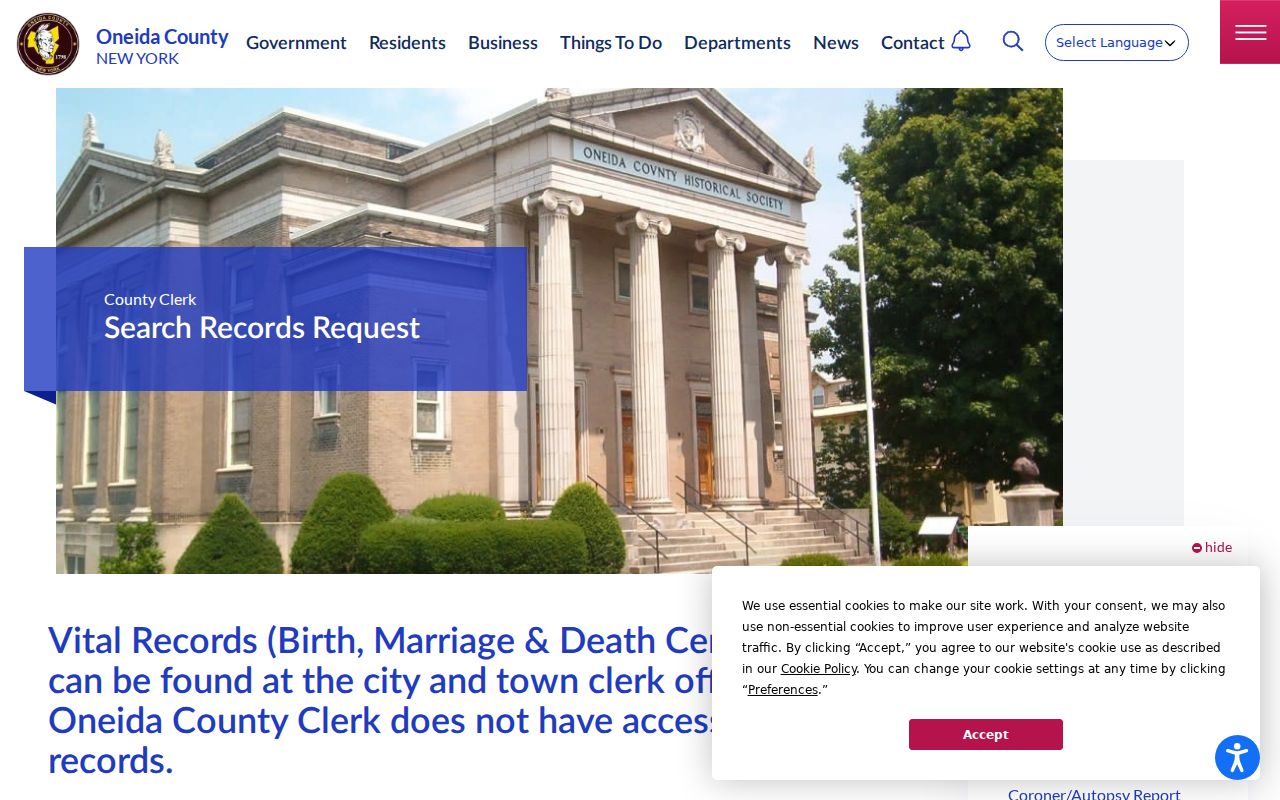
That official source confirms that a Oneida County search can continue through the clerk even when WebCriminal has no useful result.
Oneida County's Offline Criminal Files
The most important local access rule is plain: the county's public IQS database lists “Criminal Courts: No Index or Data.” The County Clerk's criminal-files page says unsealed files may instead be examined on a public terminal at 800 Park Avenue in Utica. Public hours are 8:30 a.m. to 4:15 p.m. on weekdays. A self-search at the terminal is free, and copies cost $0.65 per page. Staff searches can take up to 24 hours.
The County Clerk's official court page illustrates this courthouse-only access. It captures the gap between Oneida County's growing digital records and its criminal case index.
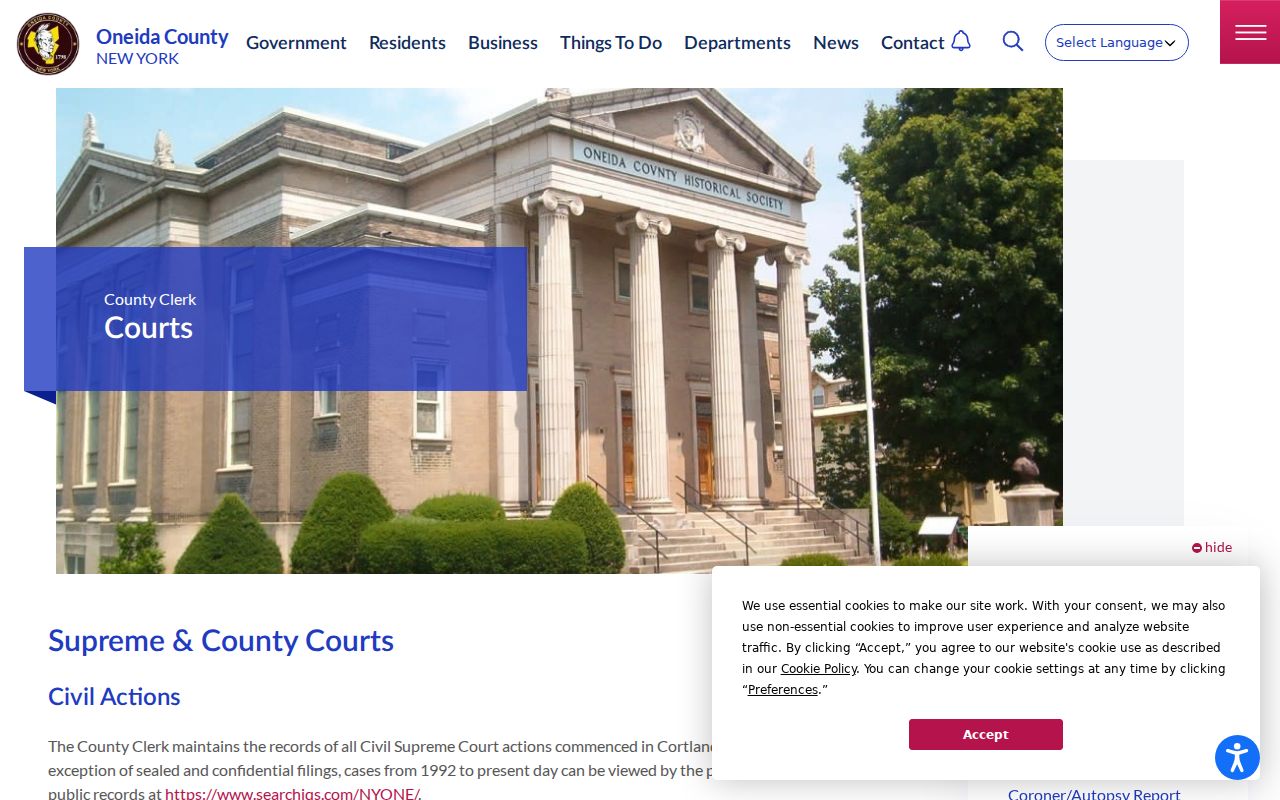
The screen points readers back to the clerk for unsealed criminal files rather than promising downloadable pleadings online.
If travel is impractical, use the County Clerk records-search channels. A mailed staff search costs $5 per name for each two-year period, even when the case number is known. Copies are extra. The PDF asks for the name, years, document type, case number if known, and requester contact information. Mail requests use a money order payable to Oneida County Clerk.
What the Case File Shows
A Oneida County criminal case file records procedure and outcome. It can identify the court, judge, parties, counsel, charge and statute, filing dates, appearances, motions, warrants, plea, disposition, monetary assessments, sentence, and orders. A docket is the dated register of events. A disposition is the recorded outcome. Neither should be confused with the first booking charge, which a prosecutor may change, add, or decline.
| Case Number and Court | Identifies the docket and the Oneida County venue that maintains it. |
|---|---|
| Charging Document | Shows the complaint, information, or indictment used to prosecute alleged offenses. |
| Docket Entries | Lists filings, appearances, motions, warrants, and orders by date. |
| Hearing Dates | Records scheduled and completed court events. |
| Disposition and Judgment | States whether a charge ended by plea, verdict, dismissal, or another result. |
| Sentence and Conditions | Records the penalty or court order imposed after a conviction. |
WebCriminal may show selected fields rather than every document. Victim information, grand-jury material, presentence reports, youthful-offender matters, and sealed records are not ordinary public file contents. Verify the exact field set at the clerk terminal before relying on an online summary.
WebCriminal Is Not Oneida's Case File
WebCriminal is a free statewide view of pending case data. It is not a download of the complete Oneida County file, a DCJS fingerprint rap sheet, or a certificate of every conviction. A blank search can reflect six distinct issues: sealing, venue, data lag, portal coverage, name variation, or a disposed matter no longer shown in the pending-case view. Call the originating clerk after testing the exact name and known docket number.
For a paid statewide court-name search, the Office of Court Administration also offers Criminal History Record Search. CHRS costs $95 for each exact name and date-of-birth combination and has statutory exclusions. It remains a court-record product. A person reviewing their own fingerprint-linked New York history must use the DCJS Record Review process instead.
Note: A portal's initial charge is an accusation, while the later disposition states how that charge ended.
Stages of a Criminal Case
Oneida County cases may begin with an arrest or appearance ticket. A local or centralized arraignment follows. Misdemeanor prosecution can proceed on an information in the local court. A prosecuted felony generally moves through a felony complaint, preliminary process, grand jury, and indictment before a County Court arraignment. Discovery, motions, conferences, plea talks, or trial then lead toward a disposition and, if there is a conviction, sentence.
Case flow: Charges Filed › Arraignment › Pretrial › Plea or Trial › Disposition › Sentencing
Oneida County opened a courtroom at the Public Safety Complex in 2017 for centralized arraignments. That can place the first court event near the jail even though later filings belong to another clerk. Searchers should follow the docket venue, not the building where custody began.
Oneida County Disposition Certificates
A certificate of disposition is the short, court-certified outcome record for one named case. It is often the best proof when a portal result is unclear or a DCJS event cycle lacks its final outcome. The official request form asks for the court, defendant's full name and aliases, date of birth, an arrest date or estimate, case number, and charge when known. Courts outside New York City charge $5. Contact the court for accepted payment methods, and never mail cash.
The Oneida County District Attorney is one party in prosecuted cases, but it is not the clerk for the court file. Its official office profile is pictured below to distinguish the prosecutor's role from the clerk's record-custody role.
The image reinforces that prosecutor records and the certified court disposition come from different Oneida County custodians.
Oneida County Problem-Solving Courts
Some Oneida County case dockets reflect a specialized track as well as the basic criminal stages. The Fifth Judicial District identifies Utica Adult and Family Treatment Court, Utica Mental Health Court, Veterans Court or Track, Oneida Integrated Domestic Violence Court, and opioid-intervention work. These programs do not turn the case file into a health or supervision file. Confidential treatment facts and presentence material remain restricted even when public docket events show the court track.
The county Criminal Public Defender represents financially eligible people in violations, misdemeanors, felonies, parole matters, and appeals across the county's broad court network. Its official page appears below as a source for the defense side of local criminal cases.
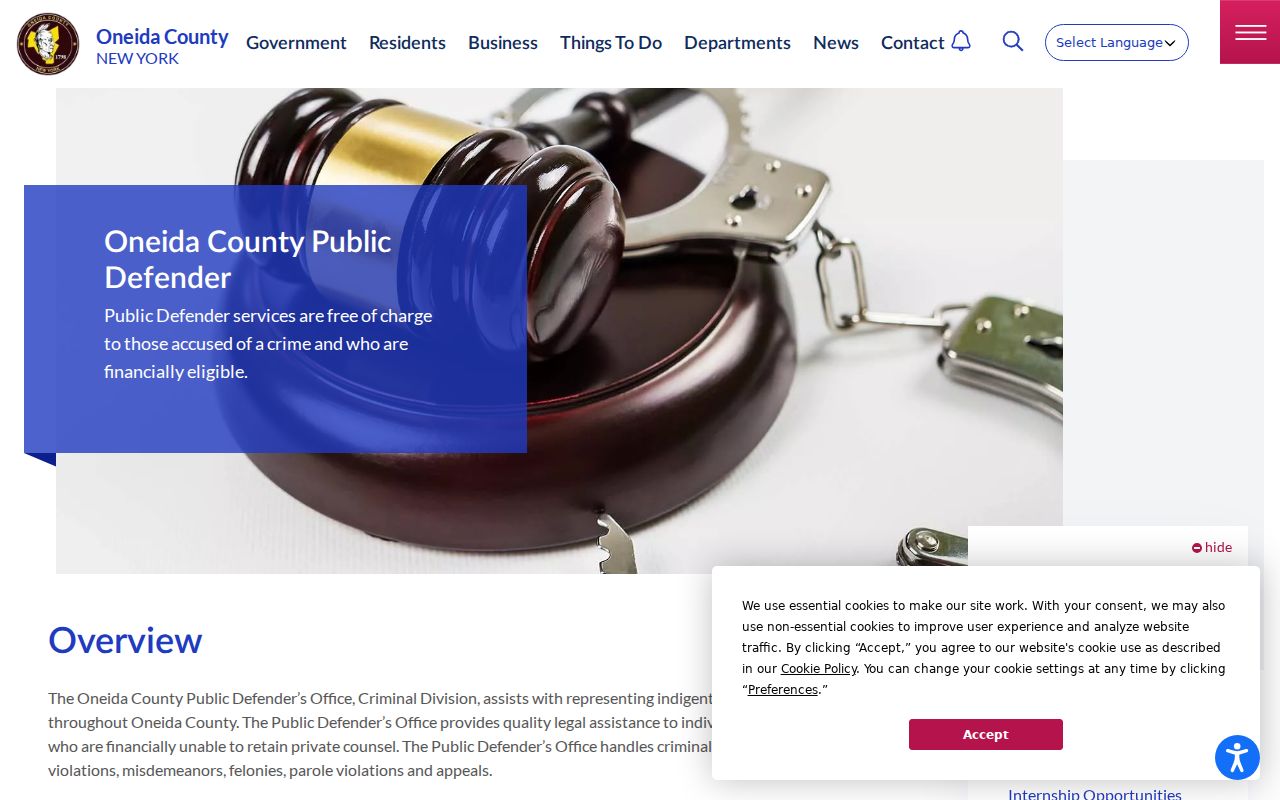
That scope explains why the defender's court list is useful for locating a case, even though each court clerk still holds its own docket.
Access & Restrictions
Open access has limits. Judiciary Law §255 directs clerks to search court records and provide lawful certificates when fees are paid. Court access follows court law and rules, not the same process used for an agency FOIL request. New York FOIL governs records held by agencies such as police or the District Attorney and permits exemptions for privacy, investigations, fair-trial rights, confidential sources, and law-enforcement techniques.
Sealed matters, youthful-offender adjudications, Family Court and juvenile records, grand-jury material, protected victim information, and presentence reports are not routine public files. CPL §160.50 generally seals records after a qualifying favorable termination. CPL §390.50 keeps presentence reports confidential except for specified access.
If a case outcome appears wrong on a person's own DCJS record, obtain the certified disposition from the originating Oneida County court. Compare it to the reported event, then use the DCJS Record Review challenge process with documentary proof. The court or contributing agency may need to correct its report before the state repository can update the compiled history.